Showing posts with label Birds. Show all posts

Tuesday, 31 December 2013

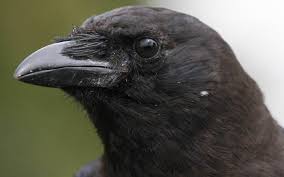
American Crow, Identification, All About Birds


Crows  are members of a widely distributedgenus of birds, Corvus, in the family Corvidae. Ranging in size from the relatively small pigeon-size jackdaws(Eurasian and Daurian) to the Common Raven of the Holarctic region and Thick-billed Raven of the highlands of Ethiopia, the 40 or so members of this genus occur on all temperate continents except for South America, and several islands. In Europe, the word "crow" is used to refer to the Carrion Crow or the Hooded Crow, while in North America it is used for the American Crow or theNorthwestern Crow.


The crow genus makes up a third of the species in theCorvidae family. Crows appear to have evolved in Asia from the corvid stock, which had evolved in Australia. The collective name for a group of crows is a flock or amurder.
Recent research has found some crow species capable of not only tool use but also tool construction and meta-tool use. Crows are now considered to be among the world's most intelligent animals with anencephalization quotient approaching that of some apes.The Jackdaw and the European Magpie have been found to have a nidopalliumapproximately the same relative size as the functionally equivalent neocortex in chimpanzees and humans, and significantly larger than is found in the gibbon.

             
Description
Corvus species are all black or black with little white or grey plumage. They are stout with strong bills and legs. The sexes are not very different in appearance.


Behaviour
Crows make a wide variety of calls or vocalizations. Crows have also been observed to respond to calls of other species; this behavior is, it is presumed, learned because it varies regionally. Crows' vocalizations are complex and poorly understood. Some of the many vocalizations that crows make are a "Koww", usually echoed back and forth between birds; a series of "Kowws" in discrete units; a long caw followed by a series of short caws (usually made when a bird takes off from a perch); an echo-like "eh-aw" sound; and more. These vocalizations vary by species, and within each species they vary regionally. In many species, the pattern and number of the numerical vocalizations have been observed to change in response to events in the surroundings (e.g. arrival or departure of crows).

Monday, 30 December 2013

Peacocks, Peacock Pictures, Peacock Facts - National Geogr

Peafowl are two Asiatic and one African species of flying bird in the genus Pavo of the pheasant family,Phasianidae, best known for the male's extravagant eye-spotted tail covert feathers, which it displays as part ofcourtship. The male is called a peacock, the female apeahen, and the offspring peachicks. The adult female peafowl is grey and/or brown. Peachicks can be between yellow and a tawny colour with darker brown patches or light tan and ivory, also referred to as "dirty white". The term also embraces the Congo Peafowl, which is placed in a separate genus Afropavo.
In common with other members of the Galliformes, males possess metatarsal spurs or "thorns" used primarily during intraspecific fights.
White peacocks are not albinos; they have a genetic mutation that is known as Leucism, which causes the lack of pigments in the plumage. Albino animals and birds have a complete lack of color and red or pink eyes while White peafowl have blue eyes. The white color appears in other domestically bred peafowl but in different quantities. Chicks are born yellow and become white as they mature, according to the Peafowl Varieties Database. Indian peafowl of all colors, including white, have pink skin.

Plumage
The male (peacock) Indian Peafowl has iridescent blue-green or green colored plumage. The peacock tail ("train") is not the tail quill feathers but the highly elongated upper tail covert feathers. The "eyes" are best seen when the peacock fans its tail. Both species have a crest atop the head. The female (peahen) Indian Peafowl has a mixture of dull green, brown, and grey in her plumage. Although she lacks the long upper tail coverts of the male, she has a crest. The female also displays her plumage to ward off female competition or signal danger to her young
The Green Peafowl appears different from the Indian Peafowl. The male has a green and gold plumage as well as an erect crest. The wings are black with a sheen of blue. Unlike the Indian Peafowl, the Green Peahen is similar to the male, only having shorter upper tail covers and less iridescence.


White 


Colouration
As with many birds, vibrant iridescent plumage colours are not primarily pigments, but structural colouration. Opticalinterference Bragg reflections, based on regular, periodic nano structures of the barbules (fiber-like components) of the feathers produce the peacock's colours. Slight changes to the spacing result in different colours. Brown feathers are a mixture of red and blue: one colour is created by the periodic structure, and the other is a created by a Fabry–Pérot interference peak from reflections from the outer and inner boundaries. Such structural colouration causes theiridescence of the peacock's hues since, unlike pigments, interference effects depend on light angle.
Colour mutations exist through selective breeding, such as the White Peafowl and the Black-Shouldered Peafowl.

             
Most beautiful Peafowl 

Thursday, 20 December 2012

Acorn Woodpecker

The Acorn Woodpecker is a medium-sized woodpecker, 21 cm long with an average weight of 85 g.

Description

The adult Acorn Woodpecker has a brownish-black head, back, wings and tail, white forehead, throat, belly and rump. The eyes are white. There is a small part on the small of their backs were there are some green feathers. The adult male has a red cap starting at the forehead, whereas females have a black area between the forehead and the cap. The white neck, throat, and forehead patches are distinctive identifiers. When flying, they take a few flaps of their wings and drop a foot or so. White circles on their wings are visible when in flight. Acorn Woodpeckers have a call that is almost like they are laughing.

Breeding communities

The breeding habitat is forested areas with oaks in the hills of coastal areas and foothills of California and thesouthwestern United States south to Colombia.This species may occur at low elevations in the north of its range, but rarely below 1000 m in Central America, and it breeds up to the timberline. The breeding pair excavate a nest in a large cavity in a dead tree or a dead part of a tree.Field studies have shown that breeding groups range from monogamous pairs tobreeding collectives of seven males and three females, plus up to 10 nonbreeding helpers. Young from a single brood have been found with multiple paternity.                                    

Food and homes

Acorn woodpeckers, as their name implies, depend heavily on acorns for food. In some parts of their range the woodpeckers create granaries or "acorn trees" by drilling holes in dead trees, dead branches, telephone poles, and wooden buildings. The woodpeckers then collect acorns and find a hole that is just the right size for the acorn. As acorns dry out, they are moved to smaller holes and granary maintenance requires a significant amount of the bird's time. They also feed on insects,sap, and fruit.

  • Behaviour

    Acorn Woodpeckers are very unusual woodpeckers that live in large groups, hoard acorns, and breed cooperatively. Group members gather acorns by the hundreds and wedge them into holes they’ve made in a tree trunk or telephone pole. Acorn Woodpeckers also spend considerable time catching insects on the wing. They give raucous, scratchy waka-waka calls frequently.
  • Habitat

    These woodpeckers live in oak and mixed oak-conifer forests on slopes and mountains in the Southwest and West Coast. They’re tolerant of humans, and you can find them in towns where there are acorns and suitable places to store them.

Pigeons


Pigeons of 
Home

Trained domestic pigeons are able to return to the home loft if released at a location that they have never visited before and that may be up to 1000 km away. A special breed, called homing pigeons has been developed through selective breeding to carry messages and members of this variety of pigeon are still being used in the sport of pigeon racing and thewhite release dove ceremony at weddings and funerals.
The ability a pigeon has to return home from a strange location necessitates two sorts of information. The first, called "map sense" is their geographic location. The second, "compass sense" is the bearing they need to fly from their new location in order to reach their home. Both of these senses, however, respond to a number of different cues in different situations. The most popular conception of how pigeons are able to do this is that they are able to sense the Earth's magnetic fieldwith tiny magnetic tissues in their head (magnetoception)[citation needed]. This is all the more surprising as they are not a migratory species, which is a fact used by some ornithologists to dispute this theory[citation needed]. Another theory is that pigeons have compass sense, which uses the position of the sun, along with an internal clock, to work out direction. However, studies have shown that if magnetic disruption or clock changes disrupt these senses, the pigeon can still manage to get home. The variability in the effects of manipulations to these sense of the pigeons indicates that there is more than one cue on which navigation is based and that map sense appears to rely on a comparison of available cues
Other potential cues used include.

About Racing Pigeons

Racing Homers are Throughbreds of the Sky
A Racing Homer is a domesticated breed of the Rock Pigeon trained to return home from long distances even in unfamiliar territory. The modern Racing Homer is a Supreme athelete of great strength and endurance.  It has been bred through selective breeding to improve its ability to race, just as selective breeding has improved other breeds of race animals.  To place the Racing Homer in the same catagory of the common street pigeon would be as analgous to placing a throughbred race horse in the same catagory with the plow nag.
  

There are  many kind of  pigeons in Pakistan and so beautiful.There  are a large number of pigeons in Pakistan. racing pigeons and lucky.


This is most beautiful pigeon.

Flying pigeon.

Saturday, 11 June 2011

Great Blue Heron


The Great Blue Heron is a large wading bird in the heron family Ardeidae, common near the shores of open water and in wetlands over most ofNorth America and Central America as well as theCaribbean and the Galápagos Islands. It is a rare vagrant to Europe, with records from Spain, the Azores, England and the Netherlands. An all-white population found only in the Caribbean and southern Florida was once treated as a separate species and known as theGreat White Heron.

Description

It is the largest North American heron and, among all extant herons, it is surpassed only by theGoliath Heron and the White-bellied Heron. It has head-to-tail length of 91–137 cm (36–54 in), a wingspan of 167–201 cm (66–79 in), a height of 115–138 cm (45–54 in), and a weight of 2.1–3.6 kg (4.6–7.9 lb).Notable features include slaty flight feathers, red-brown thighs, and a paired red-brown and black stripe up the flanks; the neck is rusty-gray, with black and white streaking down the front; the head is paler, with a nearly white face, and a pair of black plumes running from just above the eye to the back of the head. The feathers on the lower neck are long and plume-like; it also has plumes on the lower back at the start of the breeding season. The bill is dull yellowish, becoming orange briefly at the start of the breeding season, and the lower legs gray, also becoming orangey at the start of the breeding season. Immature birds are duller in color, with a dull blackish-gray crown, and the flank pattern only weakly defined; they have no plumes, and the bill is dull gray-yellow. Among standard measurements, the wing chord is 43–49.2 cm (17–19.4 in), the tail is 15.2–19.5 cm (6.0–7.7 in), the culmen is 12.3–15.2 cm (4.8–6.0 in) and the tarsus is 15.7–21 cm (6.2–8.3 in).
The heron stride is around 22 cm (8.7 in), almost in a straight line. Two of the three front toes are generally closer together. In a track the front toes as well as the back often show the small talons.
The subspecies differ only slightly in size and plumage tone, with the exception of subspeciesoccidentalis, which as well as normal colored birds, also has a distinct white morph, known as theGreat White Heron (not to be confused with the Great Egret, for which "Great White Heron" was once a common name). It is found only in south Florida and some parts of the Caribbean. The Great White Heron differs from other Great Blues in bill morphology, head plume length, and in having a total lack of pigment in its plumage. This is mainly found near salt water, and was long thought to be a separate species. Birds intermediate between the normal morph and the white morph are known as Würdemann's Heron; these birds resemble a "normal" Great Blue with a white head.
The theory that Great White Heron may be a separate species from Great Blue Heron has again been given some support by David Sibley.

Voice

The call is a harsh croak. The heron is most vocal during the breeding season, but will call occasionally at any time of the year in territorial disputes or if disturbed.Nonvocal sounds include a loud bill snap, which males use to attract a female or to defend a nest site and which females use in response to bachelor males or within breeding pairs. The bill snap may be analogous the territorial song of passerines.Bill clappering, the rapid chattering of the tips of the bill, is very common between paired herons.
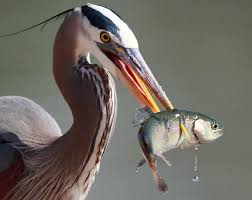
The primary food for Great Blue Heron is small fish, though it is also known to opportunistically feed on a wide range of shrimp, crabs, aquatic insects, rodentsand other small mammals, amphibians, reptiles, and small birds. Herons locate their food by sight and usually swallow it whole. Herons have been known to choke on prey that is too large. It is generally asolitary feeder. Individuals usually forage while standing in water but will also feed in fields or drop from the air, or a perch, into water. Mice are occasionally predated in upland areas far from the species typical aquatic environment.Occasionally loose feeding flocks form and may be beneficial since they are able to locate schools of fish more easily. As large wading birds, Great Blue Herons are capable of feeding in deeper waters and thus are able to harvest from niche areas not open to most other heron species.
Typically, the Great Blue Heron feeds in shallow waters, usually less than 50 cm (20 in) deep, or at the water's edge during both the night and the day, but especially around dawn and dusk. The most commonly employed hunting technique of the species is wading slowly with its long legs through shallow water and quickly spearing fish or frogs with its long, sharp bill. Although usually ponderous in movements,Feeding behaviors variably have consisted of standing in one place, probing, pecking, walking at slow speeds, moving quickly, flying short distances and alighting, hovering over water and picking up prey, diving headfirst into the water, alighting on water feet-first, jumping from perches feet-first, and swimming or floating on the surface of the water.

Baltimore Oriole

The Baltimore Oriole  is a smallicterid blackbird that commonly occurs in eastern North America as a migratory breeding bird. This bird received its name from the fact that the male's colors resemble those on the coat-of-arms of Lord Baltimore. Like all icterids called "orioles", it is named after an unrelated, physically similar family found in the Old World: theOriolidae. At one time, this species and the Bullock's Oriole, Icterus bullockii, were considered to be a single species called the Northern Oriole.

Description

This medium-sized passerine measures 17–22 cm (6.7–8.7 in) in length and spans 23–32 cm (9.1–13 in) across the wings. Their build is typical of icterids, as they have a sturdy body, a longish tail, fairly long legs and a thick, pointed bill. The body weight averages 33.8 g (1.19 oz), with a range of weights from 22.3 to 42 g (0.79 to 1.5 oz).The male oriole is slightly larger than the female, although the size dimorphism is minimal byicterid standards. Adults always have white bars on the wings. The adult male is orange on the underparts shoulder patch and rump, with some birds appearing a very deep flaming orange and others appearing yellowish-orange. All of the rest of the male's plumage is black. The adult female is yellow-brown on the upper parts with darker wings, and dull orange-yellow on the breast and belly. The juvenile oriole is similar-looking to the female, with males taking until the fall of their second year to reach adult plumage.

Distribution and habitat

These birds are found in the Nearcticin summer, primarily the eastern United States. They breed fromWisconsin to Maine and south to central Mississippiand Alabama and northern Georgia. They migrate to winter in the neotropics as far north as Mexico and sometimes the southern coast of the United States but predominantly in Central America and northern South America. Some areas of the southern United States may retain orioles all winter if they have feeders that appeal to them. The range of this bird overlaps with that of the similar Bullock's Oriole in the midwest, and the two species are sometimes considered to be conspecific under the name Northern Oriole because they form fertile hybrids.
The Baltimore Oriole is a rare vagrant to western Europe.
Baltimore Orioles are often found high up in large, leafy deciduous trees, but do not generally reside in deep forests. The species has been found in summer and migration in open woodland, forest edge, and partially wooded wetlands or stands of trees along rivers. They are very adaptable and can breed in a variety of secondary habitats. In recent times, they are often found in orchards, farmland, urban parks and suburban landscapes as long as they retain woodlots. In Mexico, they winter in flowering canopy trees, often over shade coffee plantations.